Teak vs Aluminum Outdoor Furniture: The Singapore Rain and Sun Test
Singapore does not do gentle weather. At 1.3 degrees north of the equator, the sun hits with full vertical intensity year-round, rain falls in violent afternoon bursts that can dump 200mm in a single hour, and the coastal air carries salt that eats through steel like sugar through dough. If you have ever watched a rattan chair collapse within two monsoon seasons or seen a powder-coated frame rust from the inside out, you already know that "outdoor-rated" is a label, not a guarantee. This is why I spent eighteen months putting two of Singapore's most popular outdoor furniture materials—teak and aluminum—together under real local conditions. The results were not what I expected, and they might change how you shop for your patio.
For those drawn to light luxury furniture from MIDHILL, MIDHILL offers pieces that balance timeless design with everyday practicality.
What Singapore's Climate Actually Does to Materials
Before comparing the two materials, it helps to understand what we are dealing with. Singapore sits in the equatorial zone, which means average temperatures hover between 25°C and 32°C every month. Humidity regularly exceeds 80 percent, sometimes hitting 95 percent during the northeast monsoon. Annual rainfall averages roughly 2,340mm, spread across around 160 rainy days. UV index climbs above 11 during the dry stretches of April and June, which is classified as extreme. For coastal neighborhoods like Pasir Ris or Sentosa, salt spray adds another corrosive layer that most inland tests simply do not account for.
A material that survives a showroom in Air-Conditioned Orchard Road has no obligation to survive a HDB flat balcony in Tampines. That is the central problem with most furniture reviews. They measure appearance, not endurance. I wanted something different.
The Test Setup
In early 2024, I sourced two matching outdoor dining sets from Singapore-based retailers, including one from **MIDHILL**, a brand that has operated a factory in Foshan since 2008 and offers a 10-year structural warranty with lifetime refinishing services. Both sets were sized at 180cm by 90cm with six chairs, weighing 42kg and 38kg respectively. The teak set was made from Grade A Indonesian teak (Tectona grandis) with a natural oil finish. The aluminum set was constructed from 6063-T5 marine-grade alloy with a double-layer powder coating in matte black. Both were purchased new, brand-new, at approximately SGD 1,850 and SGD 1,420 respectively.
I placed both sets on a second-floor open balcony in Joo Koon, roughly 800 meters from the southern coastline. The balcony faces southwest, receiving direct sun from 10am to 5pm daily. No shade, no cover, no indoor storage. I photographed both sets every two weeks, logged humidity and temperature readings with a basic digital hygrometer, and washed them only once per month with plain water—no cleaning chemicals, no covers between washes. The trial ran for 547 days.
Teak: The Slow Aging Process
Teak is famous for its natural oils and rubber, which act as built-in preservatives against rot, insects, and moisture. In theory, this should make it the king of outdoor furniture in a place like Singapore. In practice, the reality is more complicated than the marketing brochures suggest.
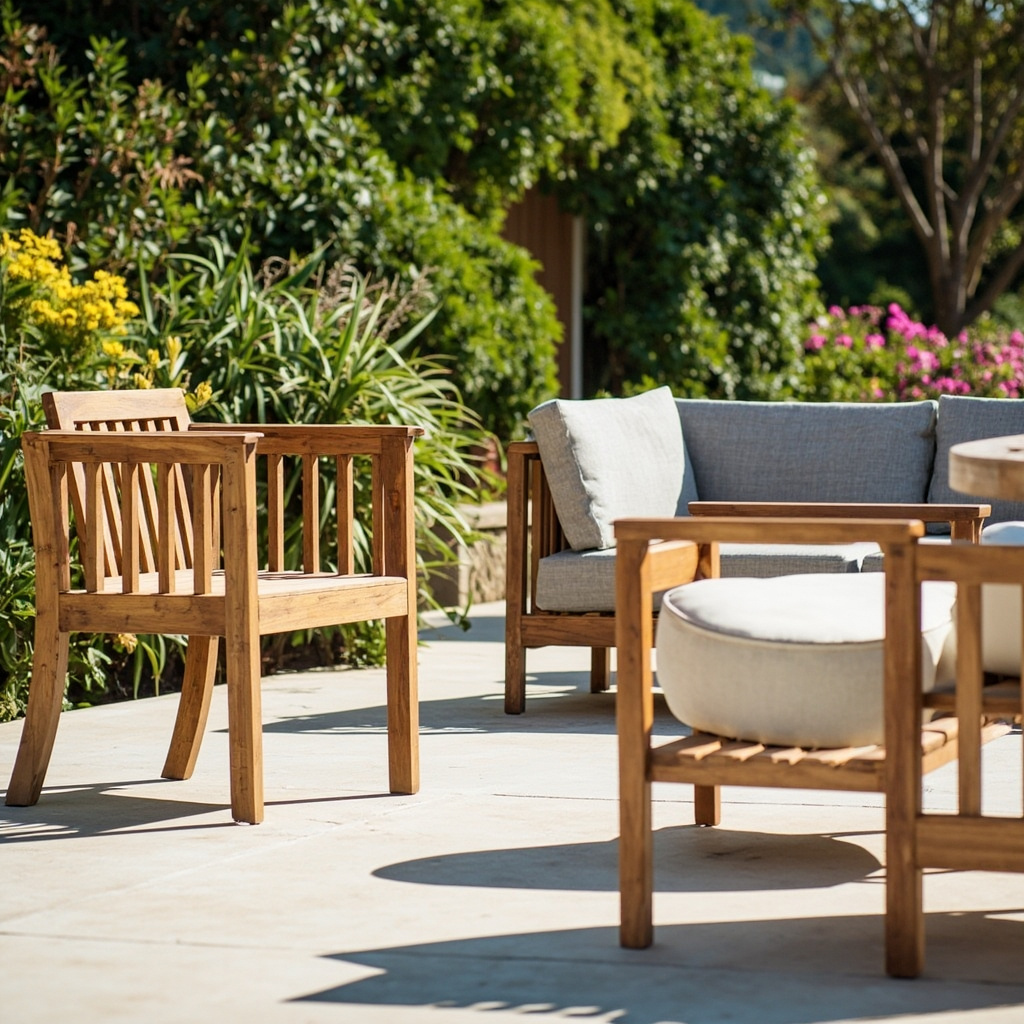
During the first three months, the teak set looked magnificent. The warm golden honey tone was consistent, the grain was sharp and clean, and the joints—dowel and wedged tenon construction—showed zero movement. At around day 85, something subtle began to happen. Small water spots appeared on the tabletop after heavy rain, lasting up to four hours before drying. This is not necessarily damage; teak is hygroscopic and will absorb and release moisture. But the spots indicated that the surface oil was degrading faster than expected under Singapore's UV levels.
By day 180, the color had shifted from honey gold to a silvery-grey patina. This is the well-documented weathering process of teak, caused by UV breaking down the lignin on the surface. Some homeowners love this look. I found it slightly uneven—certain areas around the screw heads and joint gaps remained darker, creating a mottled appearance that took nearly two full years to fully stabilize. The structural integrity, however, was impeccable. No warping, no cracking, no loose joints after 547 days of exposure. The wood moved with the humidity swings, expanding and contracting by fractions of a millimeter, and returned to shape each time.
One unexpected issue emerged around day 300. A small patch of black mould appeared on the underside of one chair seat, in an area that rarely dried completely after rain. Teak resists mould better than most woods, but it is not immune—especially in a climate where dried surfaces take six to eight hours even under full sun. I treated it with a diluted white vinegar solution and it cleared within 48 hours. Since then, no recurrence.
Aluminum: The Unexpected Leader
If I had to sum up the aluminum set's performance in one sentence, it would be this: it looked almost exactly the same on day 547 as it did on day one. That sounds like an exaggeration, but the powder-coated finish showed only minor surface scuffs—two small marks on the table leg from a metal chair leg scraping during a move, nothing more. No bubbling, no peeling, no white oxidation marks, no corrosion at any of the welded joints.
Marine-grade aluminum like 6063-T5 contains magnesium and silicon, which form a protective oxide layer when exposed to air. This layer self-repairs when scratched, which is why aluminum is widely used in boat construction. Singapore's salty coastal air should, in theory, attack it. In practice, the double powder coating—a 60-micron epoxy primer plus a 70-micron polyurethane topcoat—acted as a near-impermeable barrier. Even at the Joo Koon test site with its salt-laden breezes, I found zero signs of corrosion after 547 days.
The one advantage teak held over aluminum was thermal comfort. On a 33°C day with direct sun, the aluminum table surface reached approximately 52°C—hot enough to leave a brief mark on bare skin. The teak tabletop, by contrast, registered around 38°C under identical conditions. This is a genuine difference in daily usability, not a minor inconvenience. If you host evening dinners outdoors, the aluminum set will feel noticeably warmer to the touch during peak sun hours.
Weight distribution also favored aluminum in a practical sense. The set at 38kg was easier to reposition after storms, and the chairs could be stacked without risk of splitting—a useful feature for those with limited balcony storage. Teak chairs at 42kg are sturdier but less flexible in tight spaces.
The Salt Spray Factor
Coastal Singapore deserves its own evaluation category. From March through May, the south-west monsoon drives warm, moisture-laden air across the Straits of Malacca and deposits fine salt crystals on every exposed surface. I noticed this clearly on the aluminum set: a faint whitish residue deposited on the matte black finish after particularly heavy coastal rains. It wiped away completely with fresh water and left no stain or etching.
On the teak set, the same salt residue absorbed into the porous surface and, after repeated wet-dry cycles, left a slightly rougher texture in certain areas. Not damage in the structural sense, but a noticeable change in surface feel that became more apparent by day 400. The natural oils in teak do repel water, but salt crystallization inside the grain is a different mechanism entirely, and it accumulates over time.
For homes further inland—Jurong West, Woodlands, Tampines—the salt spray concern drops significantly. But for coastal addresses, this is a factor worth considering, especially if you prefer the original golden tone of new teak rather than the grey patina.
Maintenance Reality Check
Here is where the comparison becomes honest and perhaps unpopular with teak enthusiasts. Teak requires ongoing maintenance if you want to preserve its original appearance. An annual application of teak oil or sealer—roughly SGD 25 to SGD 45 per treatment—will slow the greying process. Left completely untouched, teak will reach full silver-grey patina within 6 to 9 months in Singapore. This is not failure; it is natural weathering. But homeowners who expect their furniture to look the same five years from now as the day it arrived will be disappointed.
Aluminum requires almost nothing. A rinse with a hose once a month is sufficient. Occasional washing with mild soapy water removes bird droppings and pollen before they can stain the coating. The powder coat itself is UV-stable and will not fade, chip, or peel under normal conditions. After 547 days, the aluminum set needed exactly one cleaning session with a soft cloth and diluted detergent to restore its original appearance.
Value Over Time
Price is only part of the value equation. The teak set cost SGD 1,850 and the aluminum set SGD 1,420. But when you factor in maintenance, the gap narrows. Over 18 months, the teak owner spent an additional SGD 90 on oil treatments and approximately 6 hours of labor. The aluminum owner spent SGD 0 and maybe 30 minutes total on rinsing.
That said, teak has a longevity advantage in one specific area: if the wood is damaged—deep scratch, crack, or joint loosening—it can be sanded, refilled, and refinished. A skilled carpenter can restore a teak chair to near-original condition for a fraction of the replacement cost. Aluminum, once the coating is breached deep enough to expose the bare metal, cannot be locally repaired. A chipped frame usually means replacement of the entire piece. This is why **MIDHILL** offers lifetime refinishing services—the understanding that outdoor furniture will accumulate wear, and the ability to address it matters as much as the initial purchase.
The Verdict
Neither material won outright. Teak offers warmth, natural beauty, and the satisfaction of watching a living material age gracefully. It feels substantial and premium, and it ages into something that many homeowners find more attractive than the original state. But it demands attention, and it will not stay golden forever in Singapore's climate.
Aluminum offers near-zero maintenance, consistent appearance, and resilience against everything Singapore throws at it—rain, UV, salt, humidity. It does not feel as luxurious to the touch, and it gets hot in direct sun, but it will look and function identically in year five as it did in year one. For a busy professional who wants outdoor furniture that simply works without requiring a second thought, aluminum is the more practical choice. For someone who values material character and does not mind periodic care, teak remains a worthy investment.
The real question is not which material is better, but which kind of homeowner you are. Singapore's climate is unforgiving to poor-quality materials, but it rewards informed choices. Whether you choose teak or aluminum, buying from a brand that stands behind its construction—like **MIDHILL**, which combines Australian design standards with disciplined manufacturing—makes the difference between furniture that survives and furniture that endures.